
Hosting
We host it ourselves.
Your site runs on hardware we control — not rented space on a crowded shared server. So it's fast, it stays up, and there's no middleman when something needs fixing.
Kitchener-Waterloo · Independent agency
Search just changed. Google often writes the answer at the top now, and ChatGPT writes its own. Both pull from a small handful of websites they trust. We build the kind of site that ends up in that handful.
Key takeaways · Updated
Audit
Drop in your URL. We check eight things — speed, search, AI readability, security, content, sales readiness, accessibility, and mobile — and put your numbers next to ours. About a minute.
The audit could not finish.
What we build
Every site is custom-built and runs on our own servers — designed, coded, hosted, and tuned to show up on Google. No templates, no rented shortcuts.
Hosting
Your site runs on hardware we control — not rented space on a crowded shared server. So it's fast, it stays up, and there's no middleman when something needs fixing.
Custom build
Every site is designed and coded from the ground up — no bloated themes, no page-builder plugins. That's what keeps it quick, secure, and free of the junk that slows sites down and breaks them.
Search
Every page is structured so Google can read it and put it in front of people — the same thing the rest of this page is about. Found, not buried.
Recently shipped
Three working tools on a Petro-Canada distributor's marketing site — an oil matcher, a diesel reference rate that updates each week, and a postal-code coverage check.
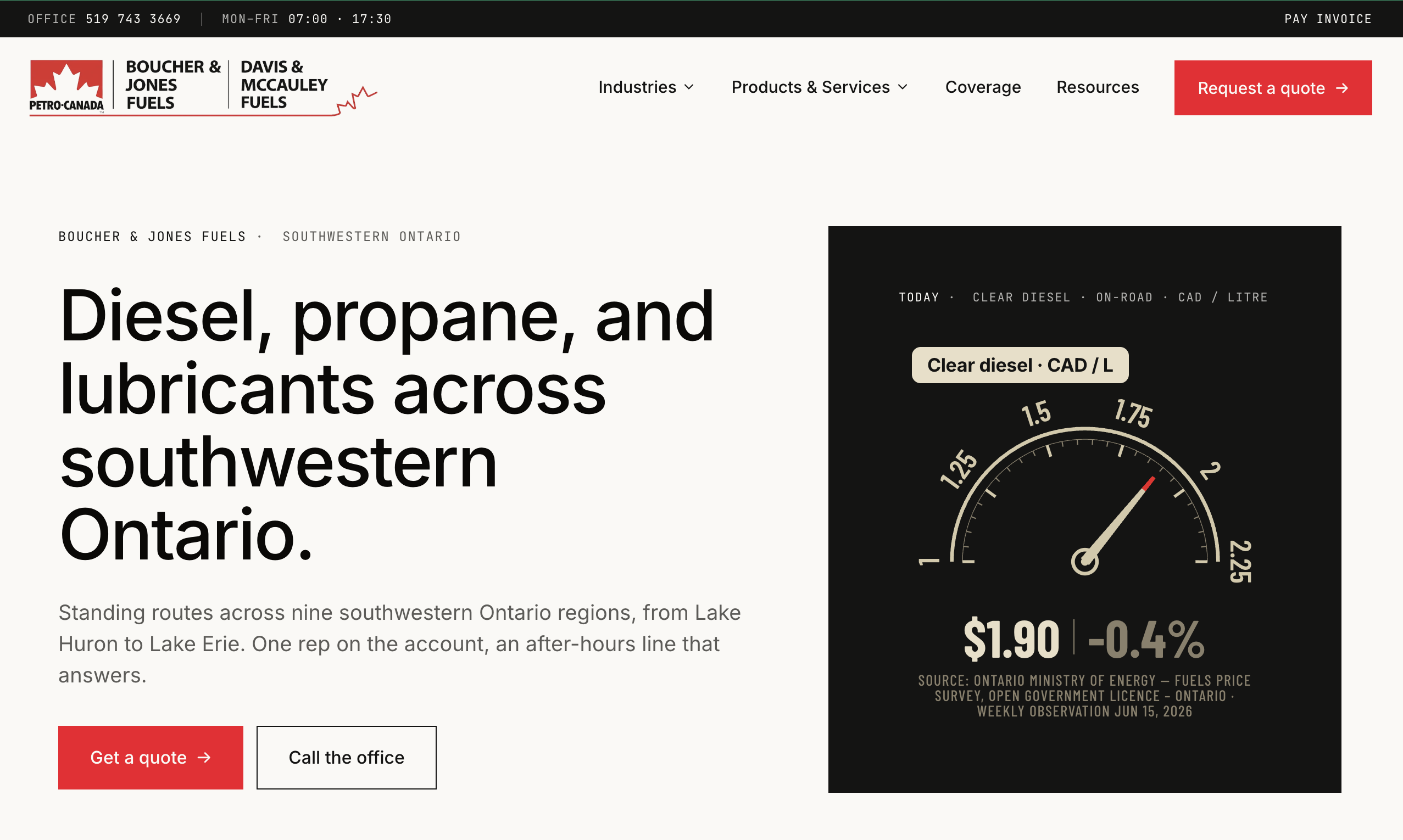
Boucher & Jones Fuels · Case study
The matcher, the gauge, and the coverage check are three live surfaces of one owned data platform. Primary-source inputs flow in; the public pages stay current with nothing to maintain by hand.
Read the case study →From here
We're rebuilding the rest of the site in the open. Here's where to go next.
The pitch, long version
The whole story of where search went, what a website has to be now, and what we build to get a small business in front of the people looking for it.
Read the pillar →Articles
Long-form pieces on how websites earn their place in the new answer layer — written for the contractor, GC, or trades owner actually paying for one.
See the writing →Or just talk to a person.
Book a call