Boucher & Jones Fuels — a working platform for a southwestern-Ontario fuel distributor
A live site with three working tools — an oil matcher, a diesel reference rate that updates each week, and a postal-code coverage check — pulling primary-source data into one platform that nobody at the distributor has to maintain by hand.
One platform, three live surfaces.
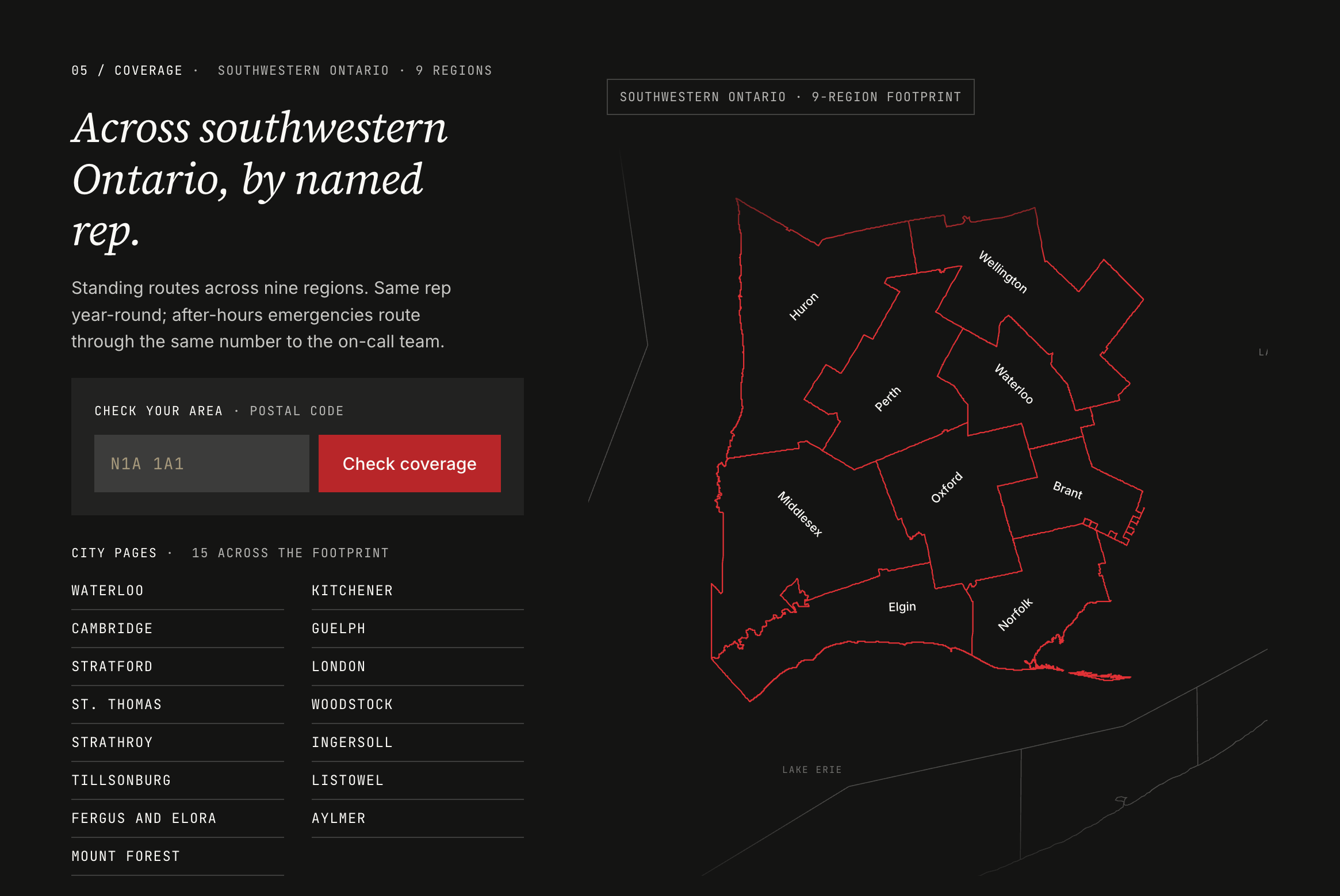
Boucher & Jones Fuels is a Petro-Canada authorized wholesale marketer running standing delivery routes across nine contiguous southwestern-Ontario counties — Waterloo, Wellington, Perth, Huron, Oxford, Middlesex, Brant, Elgin, and Norfolk — from Lake Huron to Lake Erie. Davis & McCauley Fuels, the London-area brand B&J recently acquired, is being absorbed into the same digital footprint rather than retired.
Candid built the whole platform: the marketing site, the live-data tools running on the public pages, and the data layer behind them. The page you are reading is about the second part — the working tools — because that is where the platform earns its keep.
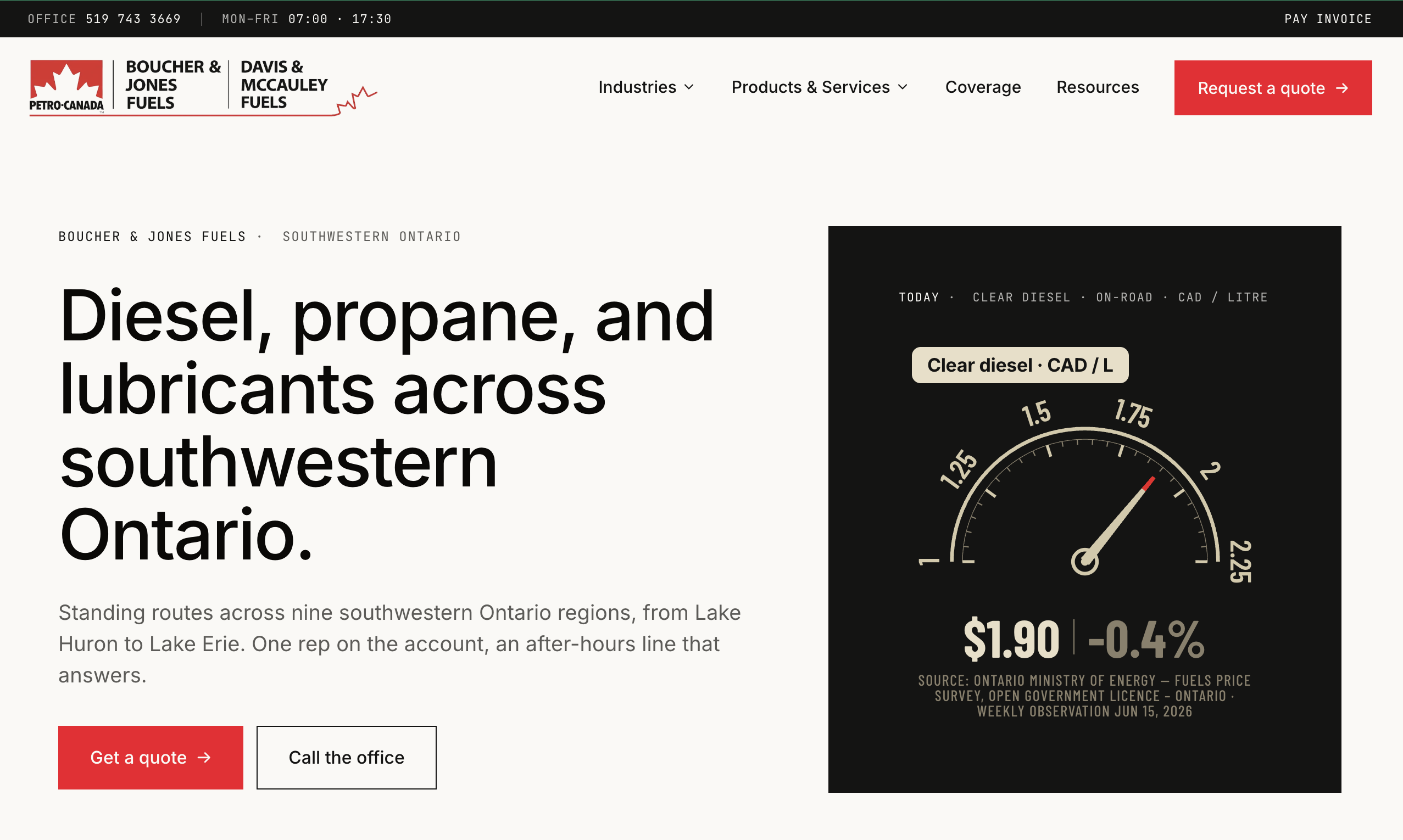
B&J home page — the diesel reference rate embedded directly in the hero panel.
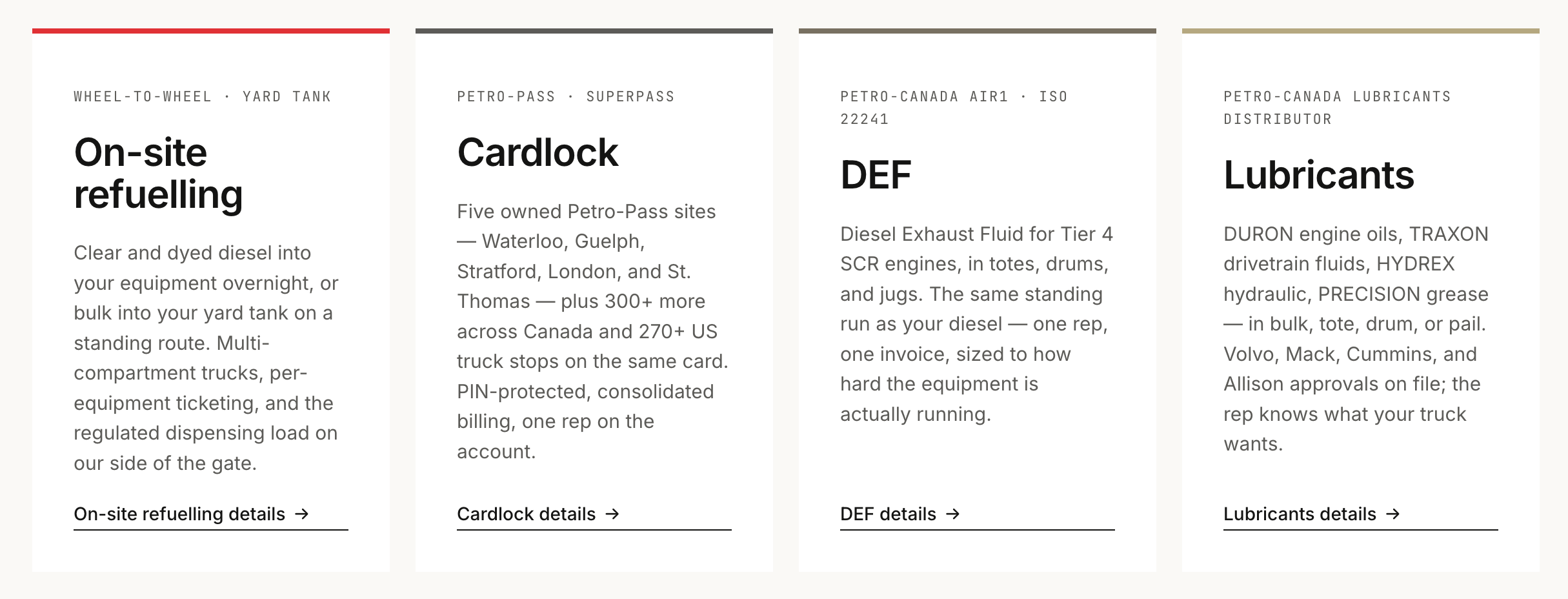
The platform serves four customer verticals, each with its own products, vocabulary, and seasonal shape: agriculture, home heating, fleet and commercial, and construction. The site IA gives each one its own hub, and the underlying data lanes are sized to how each vertical actually buys.
The four customer verticals — each its own hub on the site.
The oil matcher tells the truth about a match.
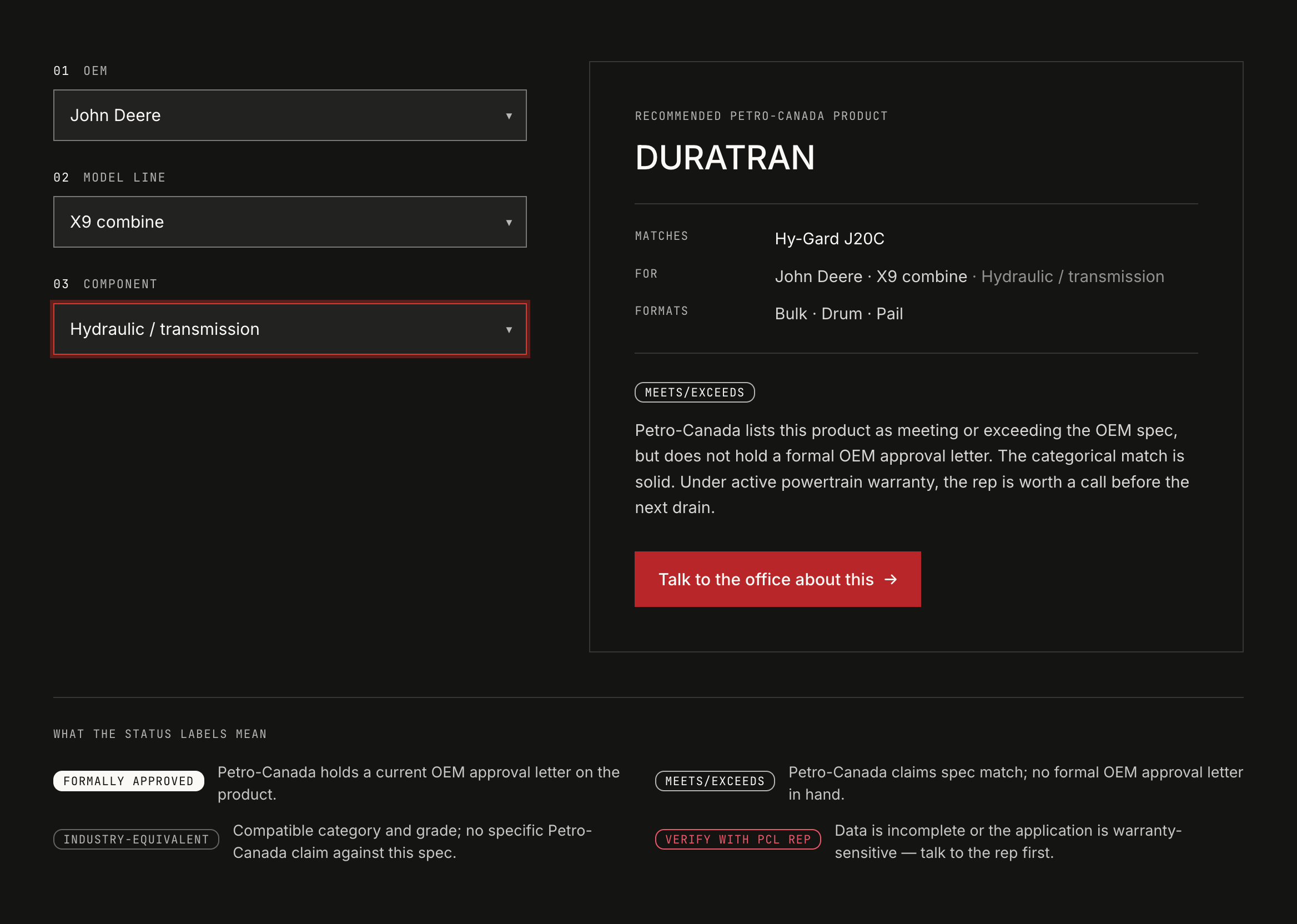
A customer picks their equipment manufacturer, the model line, and the component — John Deere, X9 combine, hydraulic and transmission — and the matcher returns the right Petro-Canada product against an OEM crosswalk. The number that matters next to that product isn't the price. It is the approval grade.
Every result carries one of four labels: formally approved when Petro-Canada holds a current OEM approval letter on the product; meets or exceeds when Petro-Canada claims spec match without a letter in hand; industry-equivalent when the category and grade are compatible but no Petro-Canada claim exists against that specific spec; and verify with the rep when the data is incomplete or the application is warranty-sensitive.
The grading is the point. Most lubricant lookups online treat every recommendation as if it were equally certain. This one doesn't. A farm running new Massey iron under warranty needs to know whether the oil it just bought will be honoured if the transmission fails. A small fleet shopping a hydraulic fluid for an older yard truck doesn't need the same level of proof. The matcher tells them which kind of answer they are looking at, in plain words, before they buy.
The customer value: pick the right oil without guessing or phoning. The honest version: if the answer is uncertain, the tool says so and points to the rep.
Oil matcher — OEM and component picked, recommended product returned with its approval grade.
A diesel reference rate that updates itself.
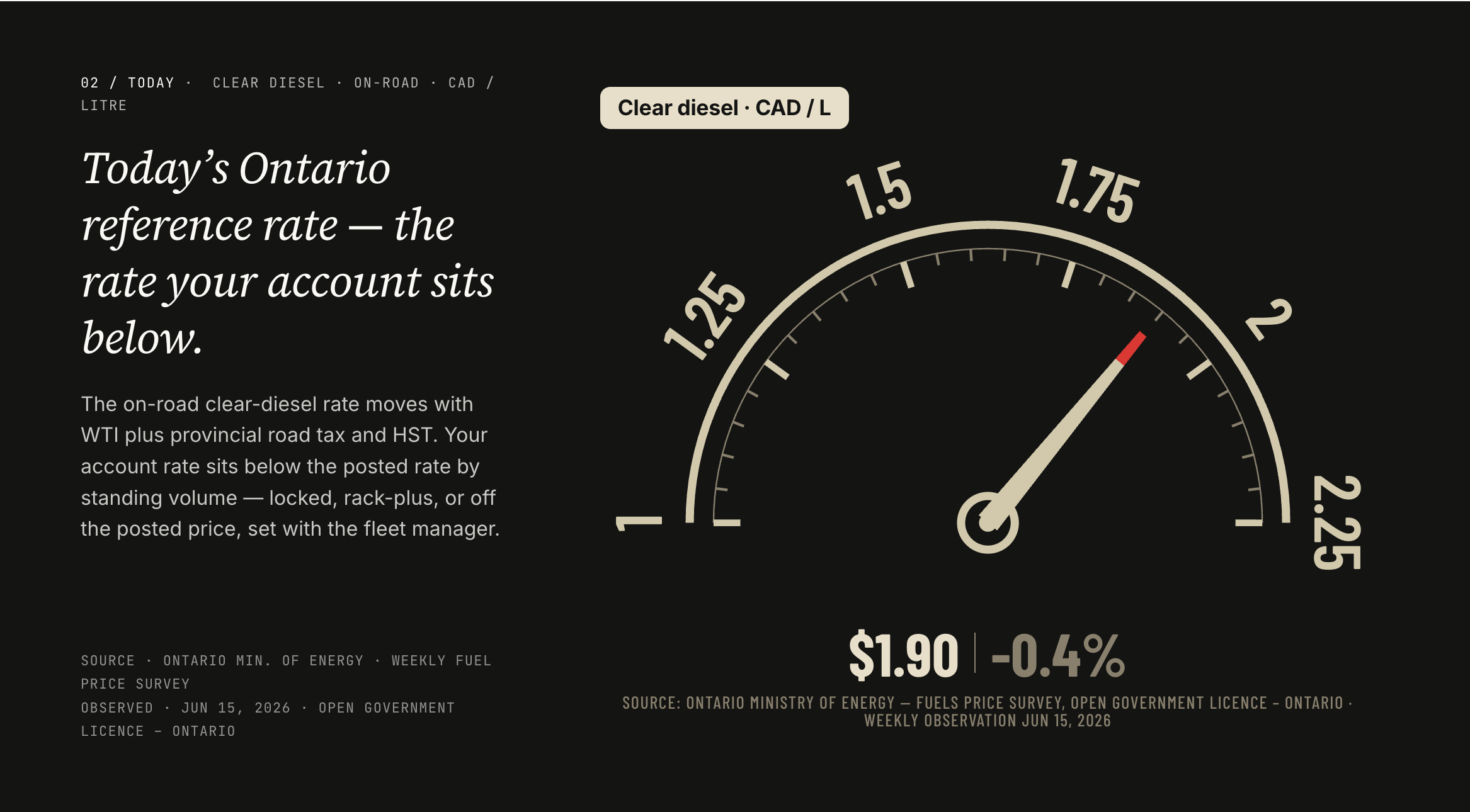
The reference panel on the home page shows today's Ontario clear-diesel rate per litre, with the week-over-week change beside it. The number, the source line, and the observation date are all rendered live from the dataset — nothing is typed into the page. When the next weekly observation lands, the panel reflects it on the next request.
The source is the Ontario Ministry of Energy Fuels Price Survey, published under the Open Government Licence – Ontario. The credit underneath the gauge reads off the same record that produced the number, including the observation date, so the citation can't drift from the figure it sits next to. The posted rate is the reference; the account rate — locked, rack-plus, or off the posted price — is set with the fleet manager and sits below it.
The customer value: see today's rate without calling. The internal value: a number on the home page that nobody has to remember to update.
Diesel reference panel — today's rate, the week-over-week move, and the source line rendered from the dataset.
A postal code answers the question on the spot.
The coverage panel asks for a postal code and answers, instantly, whether the property sits on a B&J standing route across the nine-county footprint. When the answer is yes, the page names the region and the closest standing route. When the answer is no, the page does not pretend otherwise — it returns an honest "call the office, we can sometimes accommodate spot loads," because that is what is actually true.
The customer value: an instant, honest answer to "do you deliver to me." There is no email gate, no quote form, no waiting. The reader gets the truth, then decides what to do with it.
Coverage panel — postal code input, the nine-county footprint, and the fifteen named city pages.
One engine behind the work.
The matcher, the diesel gauge, and the coverage check are three live surfaces of one owned data platform. Primary-source inputs — a provincial government energy survey, OEM lubricant reference data, the route footprint — flow into a single warehouse behind a single API. The B&J site reads them. When the source updates, the surface updates. Nothing on the customer side is hand-typed and nothing on the back office side is a duplicate spreadsheet.
That engine is a Candid product called Manifold. It is not a B&J asset and it is not the subject of this page. It is the reason the tools stay current and correct with nothing for B&J to maintain. Other sites we build, and our own, will consume from the same platform.
Built so Google can read it cleanly.
Every page on the site carries the schema markup that lets Google read it cleanly and place it — the kind of structure that gets a site picked when a buyer searches a product, a region, or a regulation. The findability is the point.
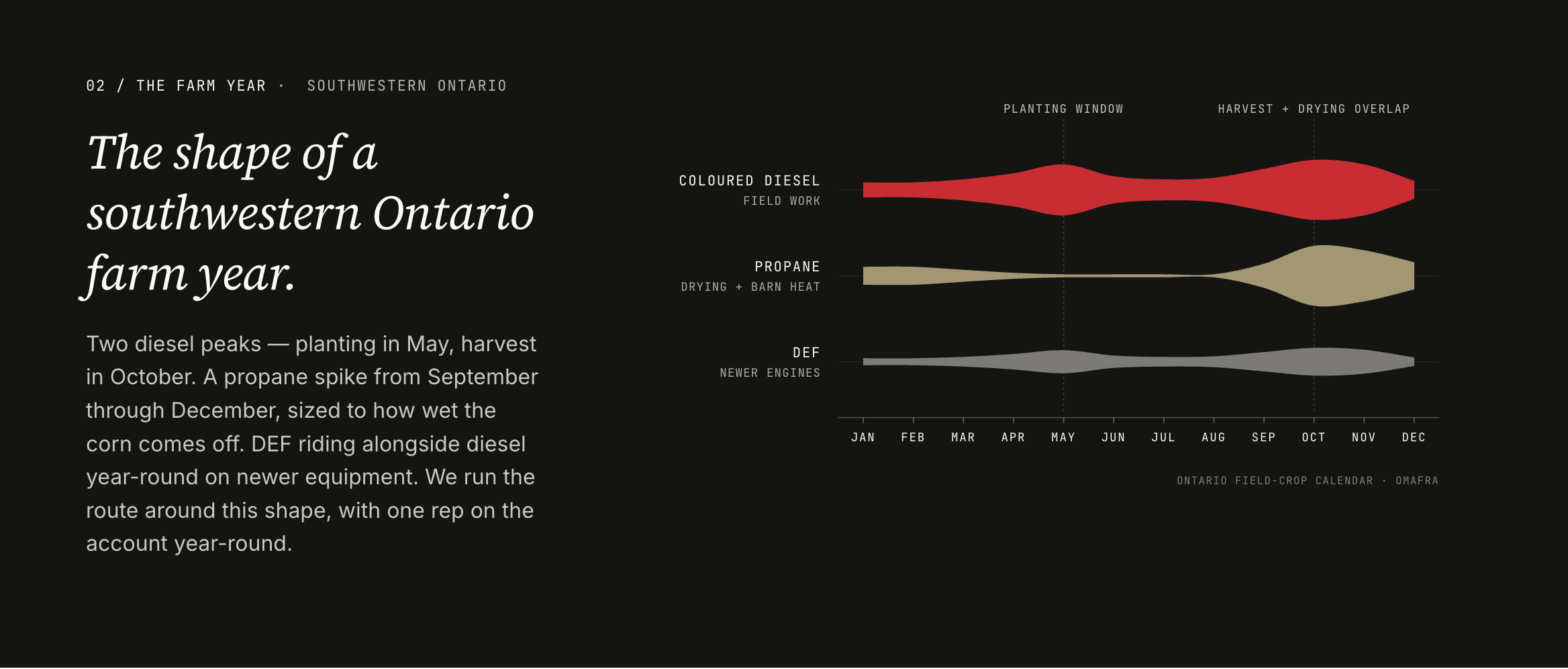
The agriculture vertical's seasonal shape, sourced from the Ontario field-crop calendar.
Roughly forty days from first commit to live.
The stack is modern and self-hosted — Next.js on the marketing site, Postgres for the structured data, our own infrastructure for the platform underneath. No subscription page-builder. The matcher, the gauge, and the coverage check were each built once and now run unattended. The kind of website we mean by Development, and the kind of site that gets Found & Trusted, are the two pieces underneath this one.